

The human brain undergoes profound transformations as we age, impacting memory, attention, decision-making, and overall mental agility. Cognitive aging involves a complex interplay between genetic and lifestyle factors, gradual cellular changes, and environmental influences. In recent decades, scientific research has explored a growing range of neuroprotective peptides and anti-aging brain compounds—proposing new strategies to maintain cognitive health later in life.
This article provides an in-depth, evidence-based overview of cognitive aging, details the mechanisms involved, and critically reviews emerging compounds including Cerebrolysin, Noopept, and Semax.
Understanding Cognitive Aging: Processes and Mechanisms
Aging affects nearly every region of the brain, but not all cognitive domains decline at the same rate. Cognitive aging refers to the gradual, subtle decline in cognitive abilities associated with normal aging—not pathological conditions like Alzheimer’s disease.
Key Changes in Cognitive Aging
- Slower processing speed
- Mild forgetfulness
- Reduced attention and multitasking abilities
- Subtle difficulties in word-finding or recalling names
Mechanisms Driving Cognitive Aging
- Synaptic loss: The number and function of synapses (connections between neurons) decline
- White matter changes: Myelin sheaths deteriorate, impacting communication between brain regions
- Neuroinflammation: Microglial activation and chronic low-grade inflammation contribute to neuronal stress
- Oxidative stress: Accumulation of free radicals leads to cellular damage
Individual Variability and Influences
While aging is inevitable, the trajectory of cognitive decline varies widely among individuals. Genetic factors, education, physical health, lifestyle, and engagement in cognitively stimulating activities all play protective roles.

The Role of Neuroprotective Peptides and Compounds
Recent research highlights the promise of neuroprotective peptides and anti-aging brain compounds for supporting cognitive health. Several such molecules—both naturally derived and synthetically engineered—aim to:
- Promote neuroplasticity
- Enhance neurotrophic support
- Reduce inflammation and oxidative stress
- Modulate neurotransmitter activity
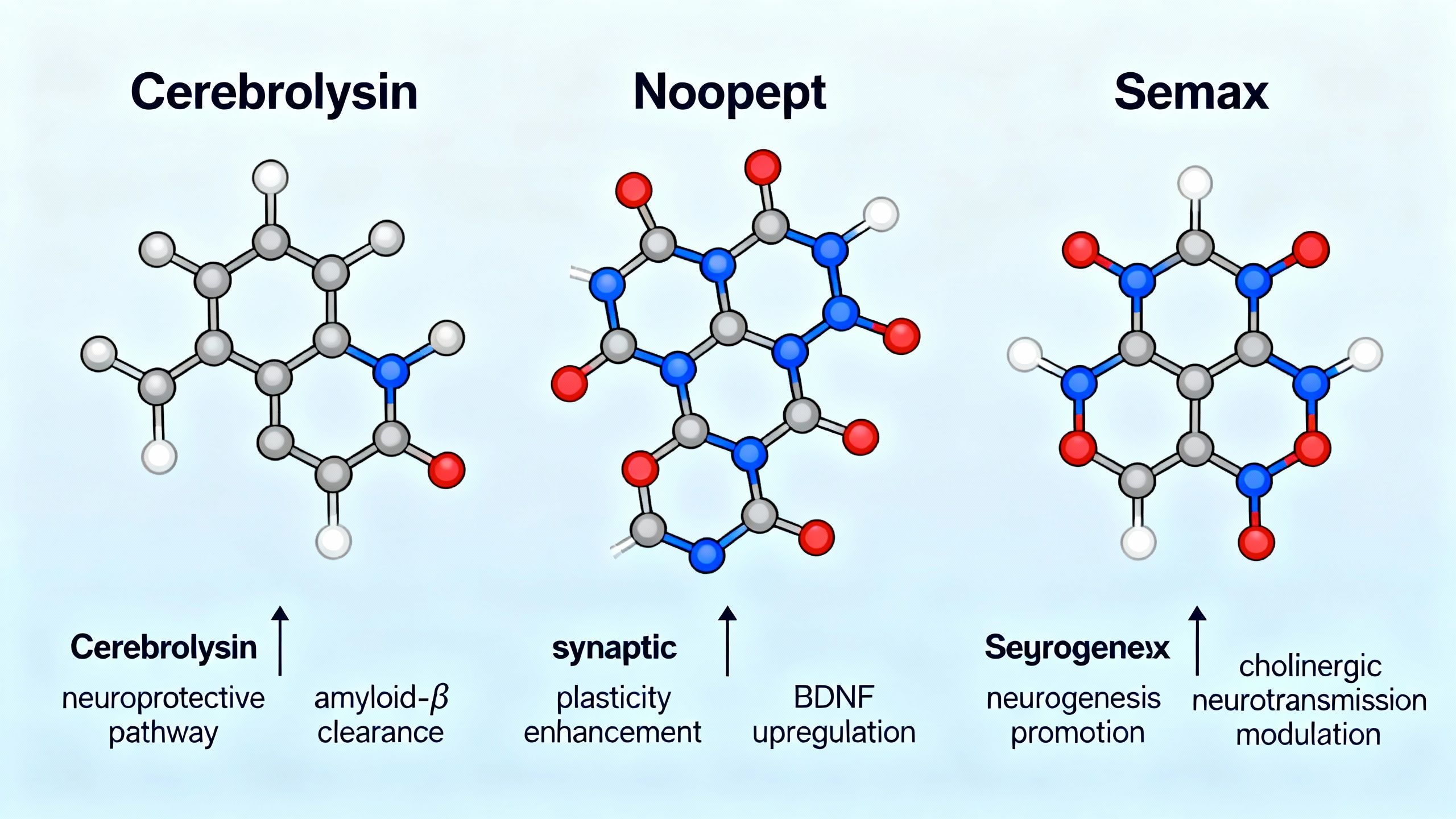
Below, we analyze three compounds receiving increasing attention in clinical research: Cerebrolysin, Noopept, and Semax.
Compound Spotlight: Cerebrolysin, Noopept, and Semax
Cerebrolysin
Cerebrolysin is a mixture of low molecular weight peptides and amino acids derived from porcine brain tissue. It has been evaluated in multiple human studies for post-stroke recovery, mild cognitive impairment (MCI), and some forms of dementia.
Mechanism of Action
- Mimics endogenous neurotrophic factors
- Enhances synaptic plasticity
- Reduces apoptosis and oxidative stress
- May facilitate neurogenesis (formation of new neurons)
Human Evidence
Studies suggest Cerebrolysin can modestly improve cognitive performance in aging populations, particularly when used as an adjunct to rehabilitation for stroke and MCI. However, benefits may wane after discontinuation, and some studies report only modest or transient effects.
Safety Profile
Generally well-tolerated; rare side effects include agitation, headache, or mild fever. Long-term safety remains under investigation.

Noopept
Noopept is a synthetic dipeptide purported to enhance cognitive function via modulation of glutamatergic and cholinergic systems. Popular in nootropic circles, clinical trials in humans remain limited but promising.
Mechanism of Action
- Increases expression of brain-derived neurotrophic factor (BDNF)
- Reduces oxidative damage
- Modulates AMPA and NMDA glutamate receptors involved in learning and memory
Human Evidence
Small-scale trials in older adults with mild cognitive impairment have demonstrated improvements in attention, memory, and mood with Noopept compared to placebo or traditional nootropics like piracetam. Larger and more rigorous studies are needed to validate these effects.
Safety Profile
Short-term studies report few adverse effects. Higher doses may cause irritability or mild gastrointestinal symptoms.
Semax
Developed in Russia, Semax is a synthetic peptide derived from ACTH (adrenocorticotropic hormone) but lacking steroidogenic effects. It has garnered interest for its potential anti-aging brain compound applications, especially due to its neuroprotective and cognitive-enhancing properties.
Mechanism of Action
- Enhances BDNF expression
- Reduces inflammation via modulation of cytokine cascades
- Increases cerebral blood flow in ischemic conditions
Human Evidence
Several randomized trials in aging patients recovering from stroke or suffering from cognitive decline indicate Semax can accelerate cognitive rehabilitation and improve overall cognitive performance over 1–3 months. Its clinical use and approval are still mainly limited to Eastern Europe.
Safety Profile
Semax is usually well-tolerated. Nasal administration occasionally causes irritation or a bitter taste. Long-term human data is sparse.
Practical Applications: Integrating Neuroprotective Strategies
How to Support Cognitive Health During Aging
While no pharmacological intervention can fully halt cognitive aging, emerging compounds may augment the effects of lifestyle interventions such as:
- Regular physical activity and aerobic exercise
- Engagement in cognitively demanding activities (learning new skills, social interaction)
- Balanced diet rich in omega-3 fatty acids and antioxidants
- Management of cardiovascular risk factors (blood pressure, cholesterol, blood sugar)
Where Do Cerebrolysin, Noopept, and Semax Fit?
These compounds may be considered as adjunctive therapies—particularly in cases of mild cognitive impairment or neurodegenerative disease under close medical supervision. They are not substitutes for foundational lifestyle measures that underpin healthy cognitive aging.
Important Caveats and Safety Considerations
- All three compounds require more large-scale, placebo-controlled human studies for robust efficacy and long-term safety data.
- Self-medication or off-label use is discouraged without guidance from a qualified healthcare provider.
- Potential interactions with existing medications (especially CNS-active drugs) warrant caution.

Table: Comparison of Selected Compounds
| Compound | Mechanism | Indications Studied | Administration | Key Limitations |
|---|---|---|---|---|
| Cerebrolysin | Neurotrophic, antioxidant | MCI, stroke recovery, dementia | Intravenous | Duration of effect, access |
| Noopept | BDNF & glutamate modulator | MCI, mild memory loss | Oral | Limited robust studies |
| Semax | BDNF enhancer, anti-inflammatory | Post-stroke, cognitive decline | Intranasal | Regional approval, sparse data |
Future Directions and Research Gaps
Cognitive aging remains an active frontier in neuroscience and geriatric medicine. Ongoing trials are testing new peptides, small molecules, and lifestyle-based interventions in diverse populations across the lifespan. As research progresses, a personalized, multi-modal approach integrating safe compounds with lifestyle strategies is likely to offer the best outcomes.
What Should Readers Do Next?
- Consult with healthcare professionals before considering any new supplement or nootropic, especially when managing cognitive decline.
- Monitor for ongoing research and clinical guideline updates
- Prioritize holistic approaches encompassing diet, activity, and cognitive engagement
Conclusion: The Promise and Caution of Neuroprotective Compounds in Cognitive Aging
The prospect of slowing or attenuating cognitive aging through neuroprotective peptides and anti-aging brain compounds like Cerebrolysin, Noopept, and Semax is both exciting and complex. While these agents may offer measurable, if modest, cognitive benefits in select populations, they are best understood as complements to—not replacements for—proven lifestyle interventions.
Ongoing research and a patient-specific, medically supervised approach remain essential for those seeking to maintain cognitive health in later life.
Studies / References
- Cerebrolysin — Mild-to-Moderate Alzheimer’s / Cognitive Impairment:
A meta-analysis of randomized, double-blind, placebo-controlled trials found that Cerebrolysin showed beneficial effects on cognitive function and global clinical change in patients with mild to moderate Alzheimer’s disease compared with placebo, with a generally favorable safety profile.
https://karger.com/dem/article/39/5-6/332/98339/Cerebrolysin-in-Mild-to-Moderate-Alzheimer-s - Cerebrolysin Clinical Context & Review (MCI / Alzheimer’s):
A clinical review summarizes decades of research showing Cerebrolysin’s neurotrophic mechanisms, cognitive benefits in Alzheimer’s and mild cognitive impairment, and safety/tolerability in human patients.
https://pubmed.ncbi.nlm.nih.gov/32808294/ - Noopept — Human Cognitive Study:
A small clinical investigation showed that Noopept (20 mg/day for ~2 months) improved cognitive scores in patients (stroke survivors with mild cognitive impairment), with a good safety profile.
https://pubmed.ncbi.nlm.nih.gov/22500312/Note: Larger, long-term placebo-controlled trials for Noopept in general age-related cognitive aging are lacking and the existing human evidence is limited.
- Semax — Stroke & Neuroprotective Evidence:
Semax has documented clinical utility in stroke recovery and post-stroke cognitive rehabilitation. One larger trial reported increased plasma BDNF and improved neurological outcomes with intranasal Semax in ischemic stroke patients.
Further research is ongoing, with one trial investigating its effects on attention and memory in healthy adults.https://clinicaltrials.gov/study/NCT04790188
https://pdfs.semanticscholar.org/2a11/334f12fff603f90a83ef1127e3192ca186b2.pdf - Semax Mechanistic Evidence & Neuroprotective Actions:
While most research remains preclinical, other controlled studies in humans — including pilot work showing Semax-associated improvements in memory and attention in small cohorts — support neuroprotective gene expression effects and cognitive modulation, though high-quality large RCTs are still needed. https://www.alzdiscovery.org/uploads/cognitive_vitality_media/Semax-Cognitive-Vitality-For-Researchers.pdf
Notes on Study Evidence
- Cerebrolysin has moderate clinical evidence through aggregated RCTs and meta-analyses showing cognitive benefits in Alzheimer’s disease and related conditions, though its use is not common in standard U.S. geriatric cognitive care.
- Noopept has very limited human research clinical evidence beyond small open-label or preliminary trials often outside mainstream Western clinical settings.
- Semax is supported largely by research in stroke rehabilitation and mechanistic studies; human data on age-related cognitive decline per se is sparse.